
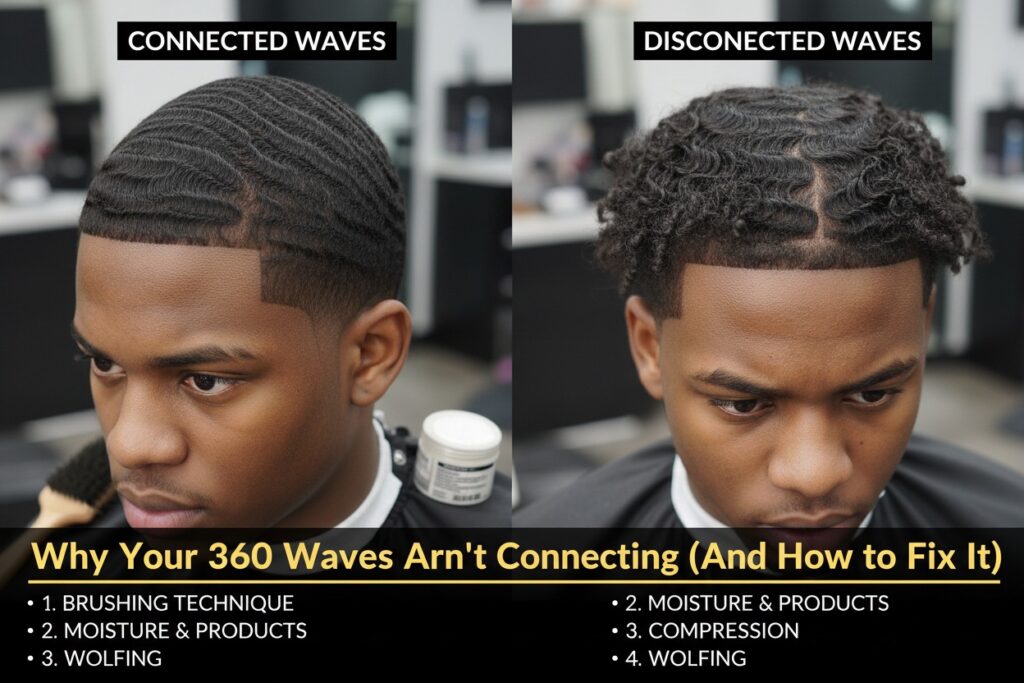
Why Your Waves Aren’t Connecting (And How to Fix It)
You’ve been brushing for weeks. Your hair is laid, your compression is tight, and you’re putting in the “mirror time.” But when you unrag, something is off. Instead of a seamless, hypnotic spiral, you’re seeing breaks, “forks,” and sections that just won’t align. It’s frustrating, but here is the truth: waves don’t just happen; they are trained.
If your waves aren’t connecting, you aren’t lacking talent—you’re likely missing a specific technical adjustment. In this guide, we’re going to break down the three “connection killers” and the exact brushing techniques you need to turn those ripples into a continuous ocean.
You’ve been brushing until your arm feels like it’s about to fall off, your durag is tied so tight it’s leaving marks, and you’re checking the mirror every twenty minutes. Yet, you still see those dreaded “forks”—those jagged lines where your waves refuse to meet up.
If your waves look like they’re in a long-distance relationship that just isn’t working out, don’t worry. Getting your waves to connect is the “boss level” of the wave game.
Here is the deep dive into why your connections are lagging and exactly how to bridge the gap.
1. The Culprit: Blind Brushing
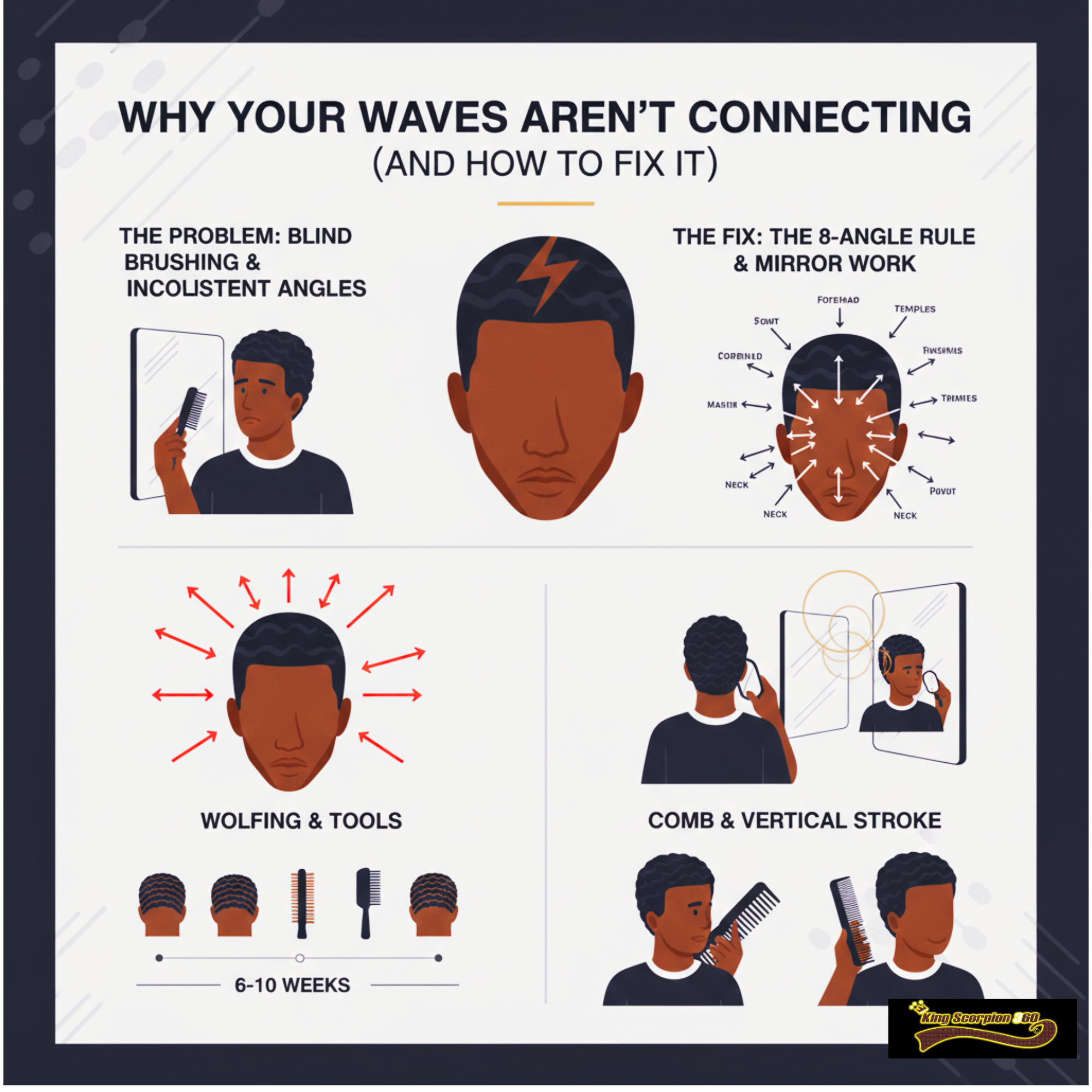
The number one reason waves don’t connect is blind brushing. If you are brushing your hair without a mirror, you are essentially guessing. Even a slight 5-degree tilt in your stroke can create a fork that takes weeks to grow out.
- The Problem: You’re brushing “down” on the sides, but “diagonally” on the back. These paths will never meet.
- The Fix: Use the Two-Mirror Method. Always have a hand mirror and a stationary wall mirror. You need to see the exact point where the brush stroke from the top ends and the stroke from the side begins. They must overlap perfectly.
2. Inconsistent Brushing Angles
Your head isn’t a cube; it’s a sphere. Most wavers fail because they treat their hair like four flat panels (Top, Back, Left, Right). In reality, you need to master the 8-Angle Rule.
| Section | Brushing Direction | Why It Matters |
| Top | Straight forward toward the forehead. | Sets the foundation for the front. |
| Front Corners | Diagonally toward the temples. | Connects the top to the sides. |
| Sides | Straight down toward the ears. | The hardest part to keep consistent. |
| Behind Ears | Diagonally toward the neck. | Often missed, causing “bald” spots in the pattern. |
| Back | Straight down toward the nape. | Connects the two side patterns. |
3. You Aren’t “Wolfing” Correctly
If you keep your haircut too low, you’ll never see connections. Connections happen when the hair is long enough to lie over the previous “wave” and link with the adjacent section.
- The Fix: You need to Wolf (the process of not cutting your hair) for at least 6–10 weeks.
- The Strategy: As your hair gets thicker, you must transition from a soft brush to a medium, and finally a hard brush to reach the scalp. If the brush isn’t reaching the bottom layer, the hair underneath will frizz and break your connections.
4. Neglecting the Crown
The crown is the “source” of your waves. If the center is messy, the ripples flowing out of it will be messy.
Pro-Tip: Use a toothbrush or a small crown brush to isolate the very center of your swirl or beehive. If you get the 360° flow right at the source, the connections at the edges of your head will fall into place much easier.
5. The “Comb” Secret
When you are deep into a wolfing session, your hair can get “clumped.” Brushing alone won’t fix the internal tangles that cause forks.
- The Fix: Comb before you brush. * Combing lifts the hair and resets the grain. When you comb in your wave pattern and then follow up with a brush, you are forcing every single hair to lie in the same direction. This is the fastest way to “break” forks and heal connections.
6. The Vertical Brush Stroke
If you see a fork (where one wave line splits into two), stop brushing horizontally.
- The Fix: Turn your brush vertically (the long way) and brush directly down the line of the fork. This narrower surface area allows you to be surgical, pulling the misaligned hairs back into the main “lane.”
Summary Checklist for Connections:
- [ ] Mirror Work: Are you looking at the connection point 100% of the time?
- [ ] Consistency: Are you hitting all 8 angles every single session?
- [ ] Tools: Are you using a hard brush to reach the scalp during your wolf?
- [ ] Compression: Is your durag high quality and kept on for at least 30 minutes after brushing?
Waves are a game of discipline and geometry. If you fix your angles and give your hair the length it needs to link up, those connections will come.
Now let’s dive deep into the most technical part of that outline: The “Blind Brushing” Trap and Identifying Your Angles. These are the “make or break” moments for any waver trying to reach elite status.
Here is the expanded content for those sections:
1. The “Blind Brushing” Trap: Why You Can’t Feel Your Way to 360s
The biggest mistake beginners make is “blind brushing”—brushing their hair while watching TV or walking around without a mirror. While it feels productive, you are likely undoing your progress. Without visual confirmation, your hand naturally drifts.
If you shift your brush stroke by even a fraction of an inch, you are essentially telling your hair to grow in two different directions. This creates “forks”—those jagged breaks in the wave pattern that haunt every waver.
- The Fix: Use the Two-Mirror Method. Position yourself with your back to a large bathroom mirror and hold a hand mirror in front of you. This allows you to see the back and crown of your head clearly. If you aren’t looking in a mirror, you aren’t training your waves; you’re just moving hair.
2. Mastering the 8-Angle Blueprint
To get a seamless 360 connection, you have to treat your head like a map. Your hair grows in a spiral from your crown, and you must follow that natural flow. Most elite patterns are built on 8 specific angles:
- Top: Straight down toward your forehead.
- Right Side: Down toward your right ear.
- Left Side: Down toward your left ear.
- Back: Straight down toward the nape of your neck.
- Four Diagonals: The “corner” areas between the top, sides, and back.
The secret to “connections” is ensuring that the stroke from your Top angle meets the stroke from your Side angle at the same transition point every single time. If these angles overlap or gap, the wave breaks.
3. Vertical Brushing: The “Surgical” Fix
When you find a stubborn fork that won’t go away, stop horizontal brushing. Vertical brushing involves turning your brush sideways so only a small row of bristles touches the hair. This allows you to isolate one specific “line” of a wave and pull it into the correct position without disturbing the surrounding hair. Think of it as a “surgical strike” for your pattern.
The Finish Line: Consistency is the Real “Cheat Code”
At the end of the day, 360 waves are a game of muscle memory—for both your hand and your hair. You can buy the most expensive crown-contour brush and the premium 2026 silk-blend durags, but if you aren’t hitting your angles with precision, those connections will stay blurry.
Fixing your waves isn’t about brushing harder; it’s about brushing smarter. Start using the two-mirror method today, identify your 8 angles, and stop “blind brushing” once and for all. Your ocean is waiting—you just have to direct the tide.
Quick Summary Checklist: Fix Your Connections Now
- Mirror Time: Never brush without seeing your crown and back.
- Angle Check: Ensure your top, sides, and back strokes meet at the “seams” without overlapping.
- Isolate the Fork: Use Vertical Brushing to pull stubborn hair into the right lane.
- The 50-Stroke Rule: Give every angle equal love to ensure a symmetrical 360 pattern.
- Compression is Key: Always rag up immediately after a session to “lock in” the work you just did.
What’s Your Biggest Wave Struggle?
Are you dealing with a stubborn “blind spot” on the back of your head, or is your crown giving you trouble? Drop a comment below or tag us in your progress photos! Let’s get those ripples moving.
More Wave Care Tips
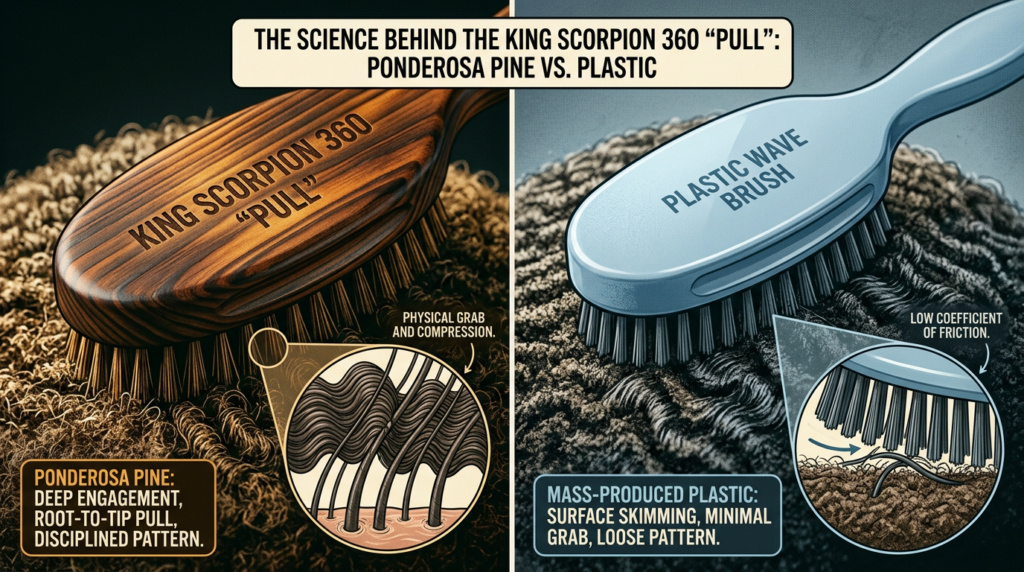
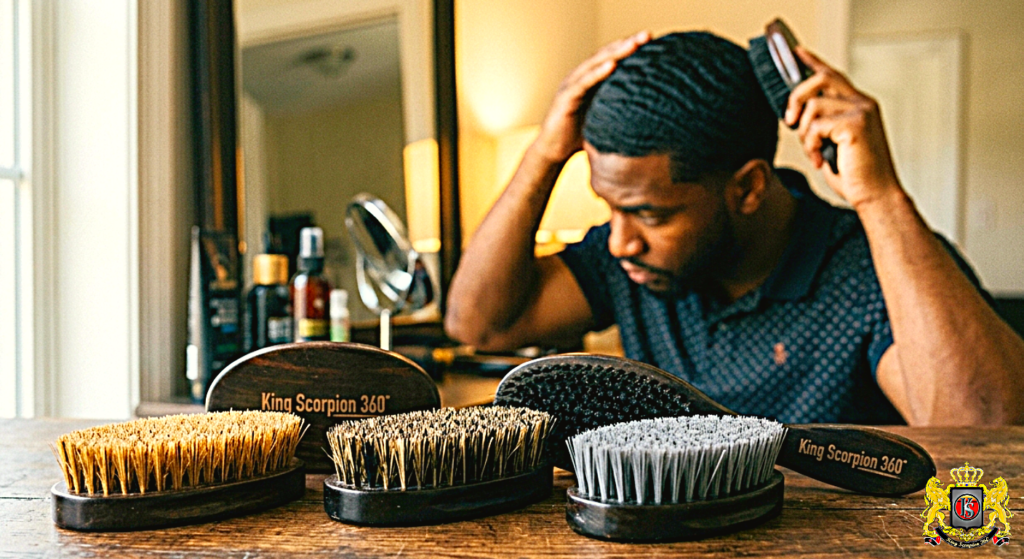
Ponderosa Pine vs. Plastic: The Science Behind the King Scorpion 360 “Pull”
In the world of elite 360 waves, the “pull” is everything. It is the tactile sensation of a brush grabbing hair from the root and shifting it into a disciplined pattern. While mass-produced plastic brushes dominate the shelves of big-box retailers, serious wavers and master craftsmen are increasingly turning toward a more traditional, high-performance material: Ponderosa Pine.
But why does a King Scorpion 360 feel fundamentally different than a standard plastic brush? The answer lies in the intersection of physics, material science, and the specific anatomy of the King Scorpion design.
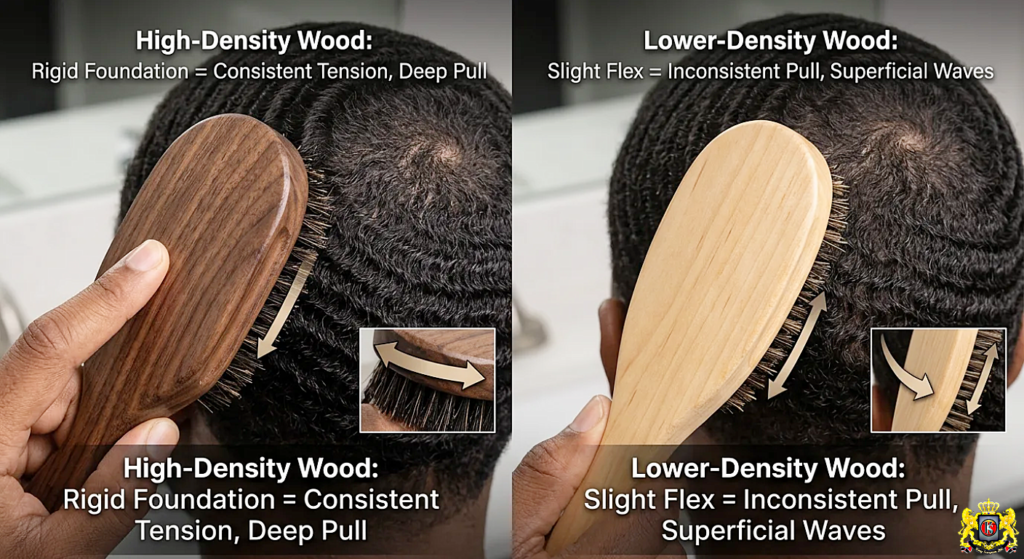
The Foundation of the Pull: How Wood Density Impacts Your 360 Waves Pattern
In the world of elite waving, the “pull” is everything. It’s that specific mechanical tension where the bristles grab the hair at the root and stretch it into the desired 360 pattern. While most focus on the bristles themselves, the choice of wood is the unsung hero that determines how that tension is delivered to your scalp.
Here is why the high-quality wood used in a King Scorpion 360 makes a functional difference:
How to Order a King Scorpion 360 Custom Wave Brush
How to Order a King Scorpion 360 Custom Wave Brush
When looking to enhance your grooming routine, especially for achieving the perfect 360 waves, a custom-made King Scorpion 360 Wave Brush can be an excellent choice. Here’s what you need to know before placing your order to ensure you get the best brush tailored to your needs.
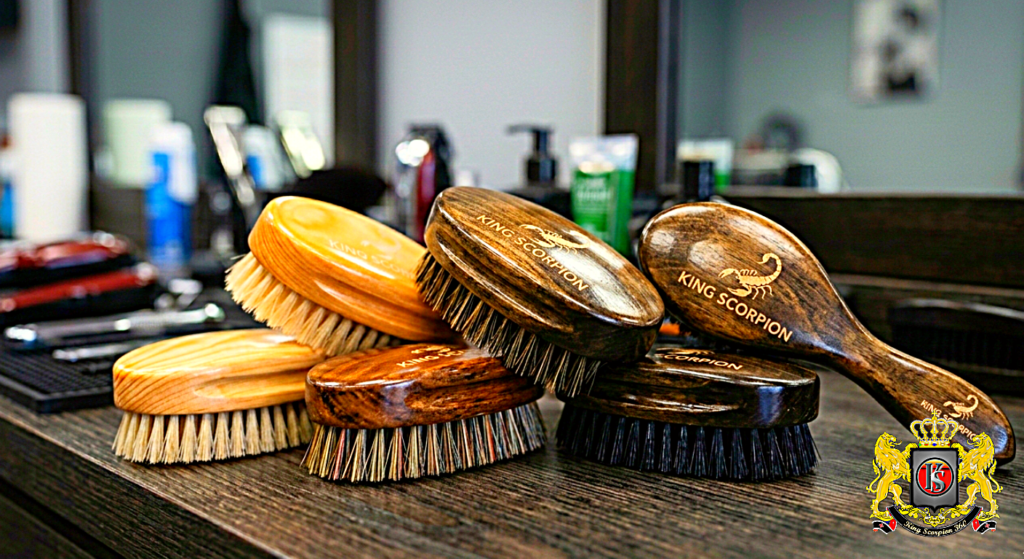
Why Is the King Scorpion 360 Wave Brush Expensive?
Discover why the King Scorpion 360 Wave Brush is worth the investment. Crafted with precision and advanced technology, this brush delivers exceptional quality and durability. With its reputation for excellence and its ability to create well-defined waves, it’s more than just a grooming tool—it’s a symbol of prestige and style. Find out why this brush is worth every penny and take your grooming experience to new heights. Shop online from trusted sites to ensure authenticity and compare prices for the best deal. Achieve flawless 360 waves with the King Scorpion 360 Wave Brush.

How to Keep Your 360 Waves Looking Good While Working Out: Sweat and Compression Tips
Maintaining deep, connected 360 waves requires a level of discipline that often feels at odds with a high-intensity fitness routine. Salt-heavy sweat can dry out hair, while movement can shift your pattern, potentially undoing weeks of “wolfing” progress in a single session.
However, fitness and waves aren’t mutually exclusive. By treating your workout as a specialized maintenance phase rather than an obstacle, you can preserve your progress while hitting your personal bests.
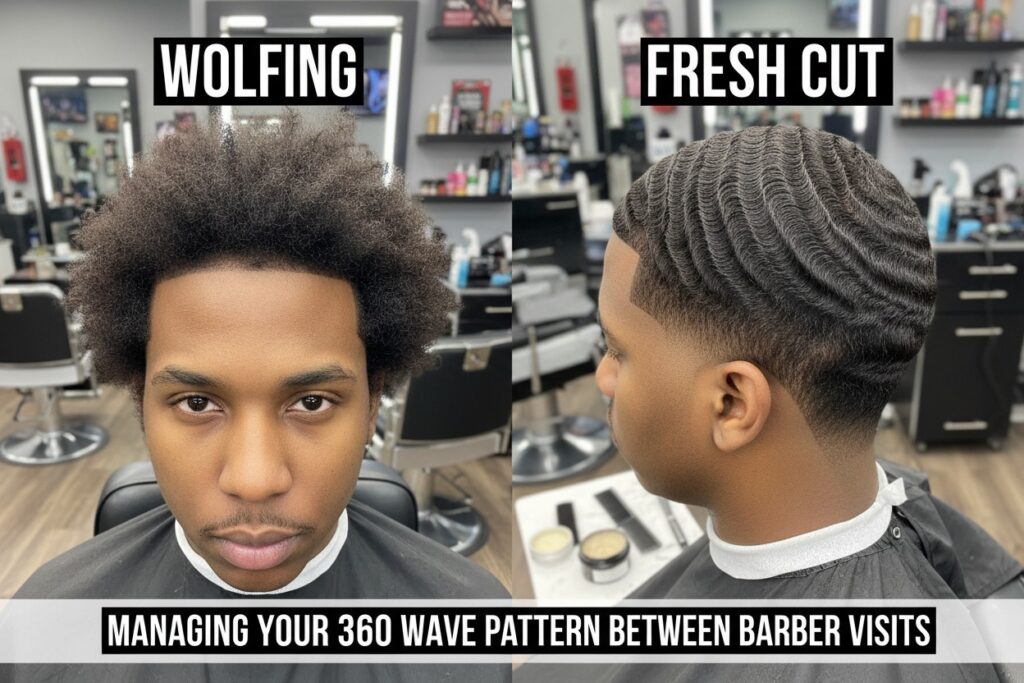
Wolfing vs. Fresh Cut: Managing Your Pattern Between Barber Visits
The wave journey is a pendulum swinging between two extremes: the crisp, flawless perfection of a Fresh Cut and the rugged, grueling discipline of Wolfing.
Most wavers look great when they step out of the barbershop. But the true masters—the ones with 3D depth and flawless connections—know how to manage their pattern when the hair gets thick and starts fighting back. The secret to elite waves isn’t just how you brush; it’s how you adapt your routine to the length of your hair.
Here is the master guide to navigating the three distinct phases between barber visits without losing your progress.

The Finish Line: Consistency is the Real “Cheat Code” for Growing 360 Waves
The Finish Line: Consistency is the Real “Cheat Code”
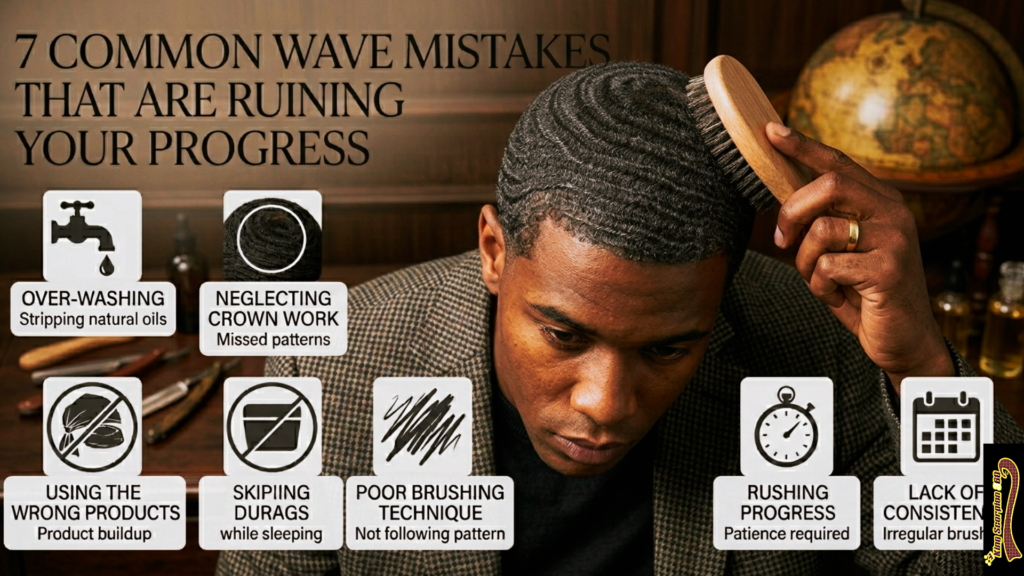
7 Common Wave Mistakes When 360 Waves
You’ve got the brushes, the durags, and the motivation. But sometimes, despite all that “brush work,” your waves seem to plateau—or worse, they start to disappear. Often, it’s not what you’re not doing; it’s the small, subconscious habits that are sabotaging your progress.
If you want to move from “beginner” to “elite,” you have to stop these 7 common mistakes that are holding your pattern back.
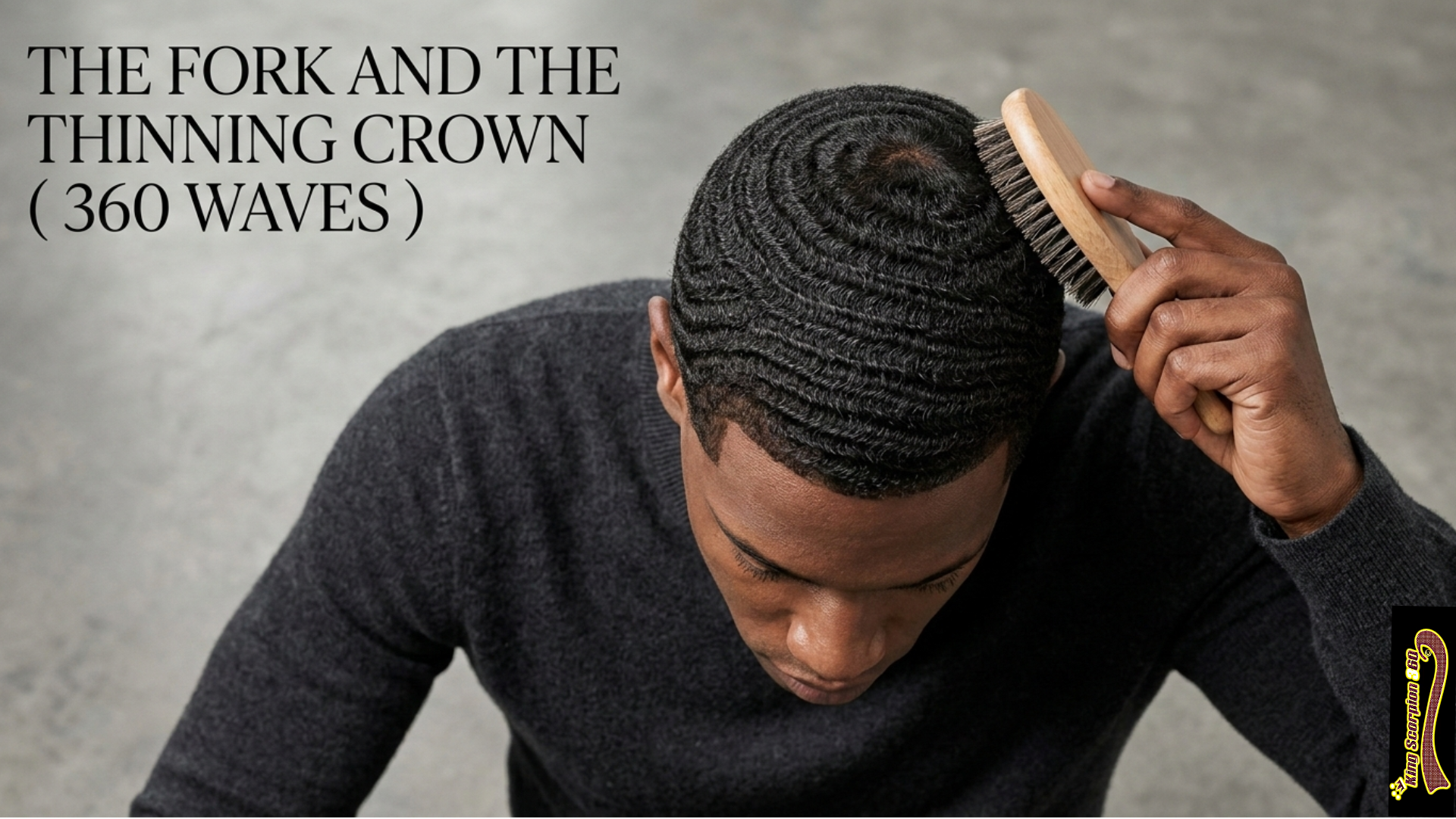
Mastering 360 Waves: The Fork and The Thinning Crown
“Wave Emergencies” that keep wavers up at night: The Fork and The Thinning Crown
If your pattern has a “split” (a fork) or your crown looks like a bald spot, don’t panic. These are fixable with “target practice” routines.

The “Blind Brushing” Trap: Why You Can’t Feel Your Way to 360s
The “Blind Brushing” Trap: Why You Can’t Feel Your Way to 360s – These are the “make or break” moments for any waver trying to reach elite status.